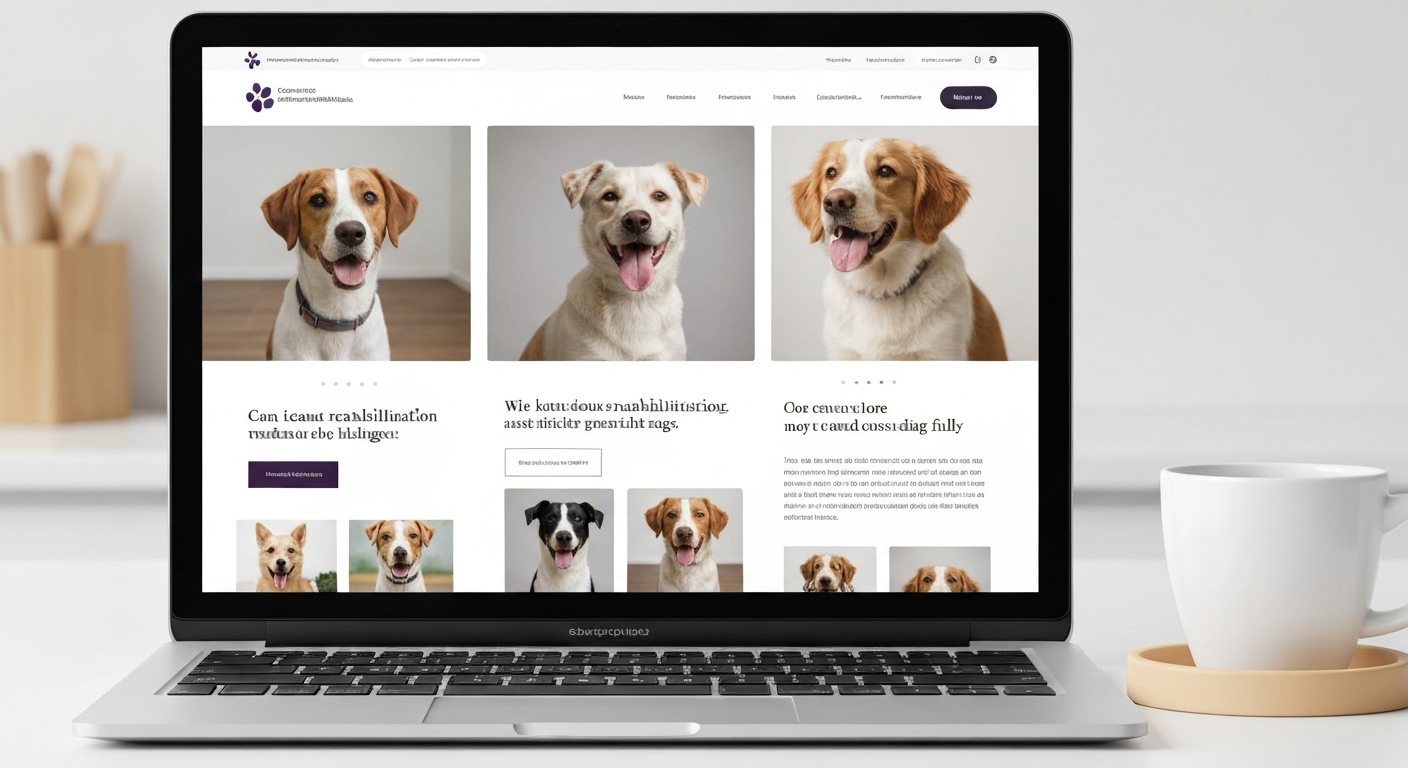
Most canine rehabilitation websites suffer from what we call the "Online Brochure Syndrome." They have a lovely picture of the staff, a long list of modalities (laser, shockwave, hydrotherapy), and a tiny "Contact Us" link hidden in the menu.
This design fails because it assumes the pet parent already knows what they need. They don't. They just know their dog is in pain. If your website doesn't immediately guide them to a solution, they will bounce to a competitor. Here are the three non-negotiable changes you need to fix a leaking website. (You can also run your site through our Local Visibility Insights tool for specific feedback).
What should a canine rehab website show above the fold?
When a user lands on your site, they should not have to scroll to figure out what you do, who you serve, and how to take the next step.
Your hero section must contain a clear, outcome-driven headline.
Bad: "Welcome to Springfield Canine Rehab."
Good: "Helping Springfield's Dogs Recover Faster and Walk Pain-Free."
"Your website has 5 seconds to convince a stressed pet parent that they are in the right place. Clarity always beats cleverness."
What is the best call-to-action for a rehab clinic website?
"Learn More" is the worst Call-to-Action (CTA) on the internet. It implies work. "Contact Us" is equally passive.
You need a direct, action-oriented CTA that tells them exactly what will happen next. Replace your generic buttons with "Book an Evaluation" or "See If You Qualify." Make this button a highly contrasting color and place it in the top right corner of your navigation menu, as well as dead center in your hero section.
How do you use social proof to sell canine rehab?
Written testimonials are great, but in canine rehab, seeing is believing. You need visceral, visual proof that your treatments work. Embed a short video montage showing a dog struggling to walk on Day 1, followed by them trotting happily on Day 30. This creates an emotional response that no amount of written text can replicate. When a pet parent sees a dog just like theirs getting better, price becomes secondary.
Frequently Asked Questions
Get the Free Canine Rehab Growth Checklist
Get practical canine rehab growth insights and our 24-point growth systems checklist delivered to your inbox.